


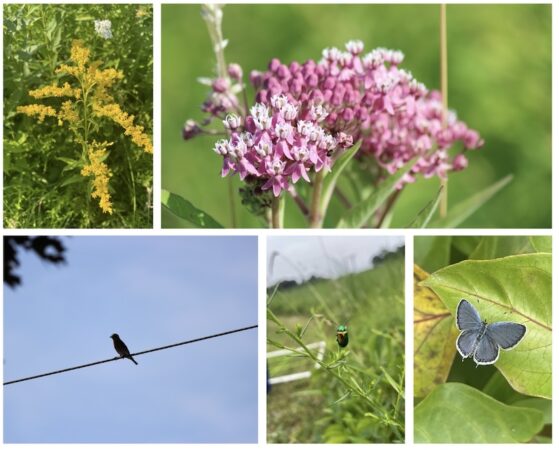
From top to bottom, left to right: Early Goldenrod, Milkweed, unidentified bird, Dogbane Leaf Beetle, Eastern Tailed Blue.
By Malibu Slattery
Hi! I’m Malibu Slattery! I was an intern here at the Dennis Conservation Land Trust (DCLT) during the summer of 2025, following two previous summers of volunteer work. I’m currently in my final year at the University of California, San Diego, set to graduate in 2026 with my degree in Ecology, Behavior and Evolution and a minor in Environmental Studies.
I had the privilege, under the guidance of DCLT Executive Director Dr. David Fryxell, of exploring the beautiful expanse of meadow beside Not Enough Acres Farm this past summer. With the idea of expanding the ever dwindling population of pollinators, as well as improving a critical bird and mammal habitat, DCLT is taking on the daunting task of mass wildflower seed dispersal over this meadow. In order to best assess the ways in which seed cultivation and species protection should be carried out, David set me loose to sample plant (and the occasional insect) composition in the mini jungle next door.
I was equipped with a hand-crafted quadrat (for counting within a specific area), tyvek suit (for tick and poison ivy protection) and my trusty clipboard! Over the months of June, July and August, I was able to research and work on the past, present and continuing even now, future of this stunning piece of land.
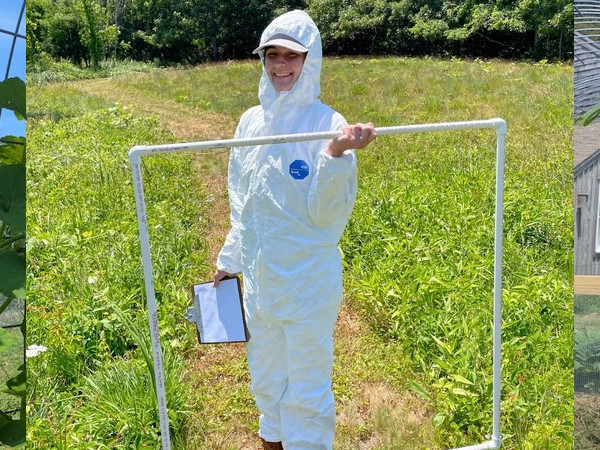
One of the main issues to tackle is the invasive, tangling plant “black swallowwort” that riddles a large chunk of the meadow. This species tends to crowd out other species, especially low growing ones, with its cover and strangling vines. It can also be deadly to monarch butterflies. The end goal of this project is to improve pollinator health and habitat by both removing this invasive plant and planting native wildflower seeds.
In light of the shifting appreciation and focus to woodland conservation on Cape Cod, it is important to highlight how meadows also serve as key habitats for certain species of nesting birds. To divert attention away from these disappearing gems is to lose historic habitat diversity, and species diversity with it.
This initiative, while large in scope, is an important one. It is a good step towards preserving one of the many diverse ecosystems found on Cape Cod and will hopefully prove to have a fruitful outcome. I am but one piece of this puzzle, a picture to be painted in the dappled light cast above fluttering flowers and buzzing bees, and those very creatures are the rest.