


Community Biodiversity Initiative
Stoking Biodiversity Conservation Action across the Commonwealth

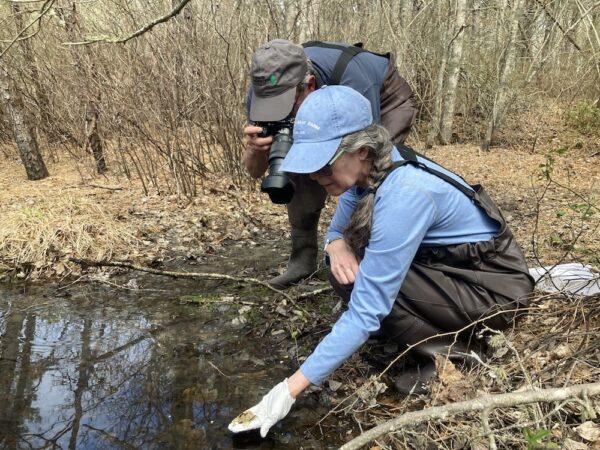
We are living through a global biodiversity crisis. Around the world, species are disappearing at an accelerating pace due to habitat loss, overexploitation, pollution, invasive species, and climate change. Despite the urgency of the problem, three persistent challenges continue to limit effective biodiversity conservation: insufficient data and knowledge, inadequate funding, and a lack of political will. Massachusetts is no exception.
One of the most powerful ways to address these challenges is by leveraging local conservation organizations and the volunteers who support them. Massachusetts is home to hundreds of such organizations, including land trusts, watershed and pond groups, conservation commissions, and municipal natural resource departments.
Collectively, these organizations steward thousands of acres of conservation land, are deeply connected and knowledgeable in their local communities, and engage large networks of volunteers, positioning them to significantly expand biodiversity monitoring and protection at the level needed most: the local level.
At the same time, citizen scientists in Massachusetts have an incredible and unique opportunity to directly contribute to biodiversity protection. By documenting state-listed species and “obligate” vernal pool species and submitting observations through the proper channels, the data generated will be used by scientists, planners, and regulators to protect sensitive habitats.
Despite this enormous opportunity, participation has varied widely among communities, and reporting rates have declined significantly over the past two decades. The Community Biodiversity Initiative (CBI) was created to reverse that trend.
The CBI uses publicly available datasets to recruit, motivate, and support local conservation organizations in developing volunteer-led species reporting programs. Now working with 13 partner organizations across Massachusetts, and actively recruiting others, we conduct statewide analyses to identify locations where species observations are most needed, provide training and field guidance for volunteers, and help partners establish sustainable reporting efforts in their own communities.
Together, the CBI’s partners generate dozens of new species reports each year while strengthening public engagement in vernal pool certification and rare species conservation.
By empowering local volunteers and organizations, the CBI is helping communities reconnect with the wildlife and habitats around them and ensuring that the information needed to protect Massachusetts’ most ecologically important places continues to grow.
How It Works
The CBI focuses on two pathways from species reporting to legitimate biodiversity protection. First, the certification of vernal pool habitat, and second, the monitoring of and reporting to MassWildlife of state-listed species. In both cases, reports lead to added legal protections to the land where these species are found, making these tools one of the most direct ways your organization’s volunteers can contribute to biodiversity protection.
From the land trust perspective, with the primary goal of protecting land, this is the among the most impactful and direct ways to get volunteers involved in legitimate land protection; it is our opinion that that these activities should be another tool in the land protection toolkit used by all the land trusts in our state.
Vernal Pools
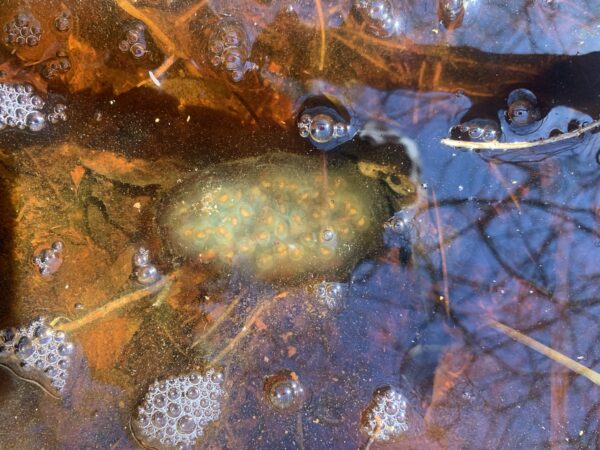
Vernal pools are isolated, seasonally flooded depressions in the landscape that provide essential breeding and nursery habitat for a vast diversity of amphibians and macroinvertebrate species. They support disproportionately high biodiversity relative to their size and play a critical role in broader ecosystem processes, including nutrient cycling and the movement of organisms across forested landscapes.
Yet despite their ecological importance, vernal pools remain among the least protected wetland types in Massachusetts.
However, when certain species are found in vernal pools following the state’s protocol, the pool can become officially “certified,” triggering a host of benefits:
- Regulatory Protection: Certification triggers permit review for proposed work under the Massachusetts Wetlands Protection Act (MWPA) and other regulations.
- Land Acquisition: Certification adds “conservation value” and improved funding opportunities for land acquisition.
- Land use planning: Certified pools are incorporated into analyses by land use planners and environmental consultants, e.g. for determining siting of development and public utility facilities.
- Mosquito control: Certified pools have less impactful treatment recommendations under the state’s Best Management Practices for mosquito control.
- Bottom Line: Certification transforms an otherwise invisible habitat feature into a highly visible and protected biodiversity asset.
Listed Species
When found, species listed under the Massachusetts Endangered Species Act should be documented and reported to MassWildlife. Reports are submitted through Heritage Hub. Eventually, they are reviewed by NHESP staff, and if the observation is accurate and complete, they will update the Rare Species Viewer Database reflecting the species you reported. Then, the next time NHESP periodically reviews and updates their Priority Habitats of Rare Species datalayer, typically every 4-5 years, your observation could lead to the maintenance, expansion, or creation of protected Priority Habitat. Importantly, the Priority Habitat designation is regulatory in nature; it provides legal protections to the habitat and the species it contains. Any proposed work or disturbance in these areas requires additional permit review and can lead to permit denial, or monitoring and mitigation requirements.
Results: How Are We Doing?
Our data-driven approach to motivating and prioritizing locations for involvement used these datasets to answer the questions that follow:
- Certified Vernal Pools
- Potential Vernal Pools
- Rare Species Viewer Data
- iNaturalist’s Geomodel Predictions
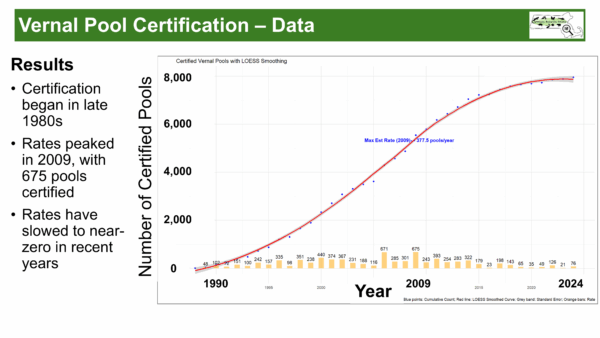
Vernal Pools – How frequently are pools being certified?
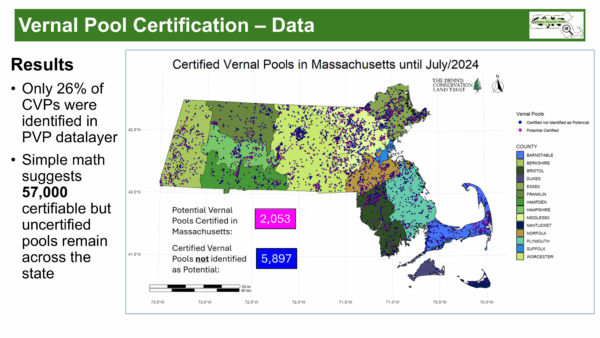
Vernal Pools – How many uncertified but certifiable pools remain?
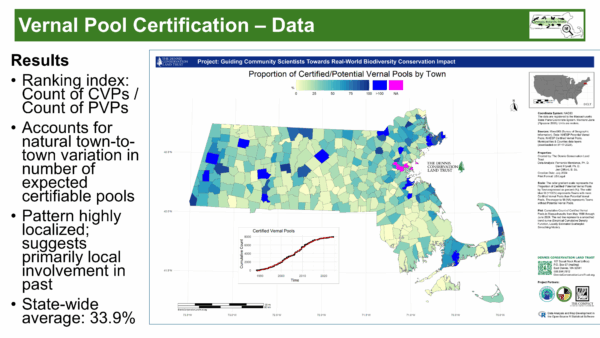
Vernal Pools – Which communities have lagged the most?
Listed Species – How well are we regularly reporting state-listed species?
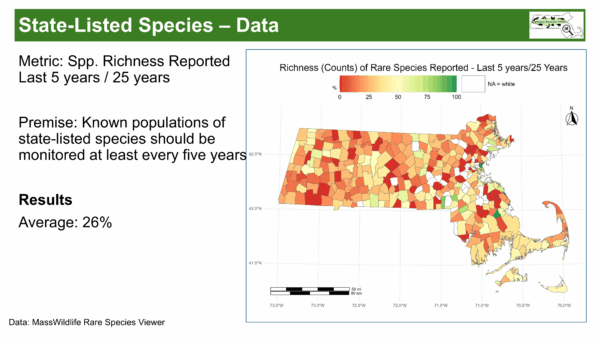
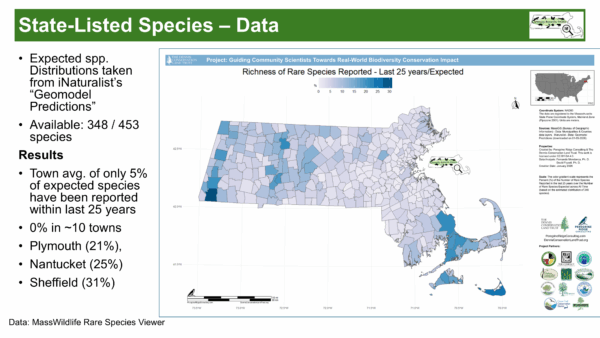
Listed Species – How many of the expected species have been reported?
Where Does Your Community Stand?
Using the above metrics we developed and report rankings of every town across the state. To see where your community stands, click on your town’s county below.
Barnstable, Dukes, and Nantucket Counties
- Vernal Pool Certification Index
- Proportion of Expected State-Listed Species Actually Reported
- Proportion of Active Listed Species Observations Reported Within the Last 5 Years (coming soon)
Berkshire County
- Vernal Pool Certification Index
- Proportion of Expected State-Listed Species Actually Reported
- Proportion of Active Listed Species Observations Reported Within the Last 5 Years (coming soon)
Bristol County
- Vernal Pool Certification Index
- Proportion of Expected State-Listed Species Actually Reported
- Proportion of Active Listed Species Observations Reported Within the Last 5 Years (coming soon)
Essex County
- Vernal Pool Certification Index
- Proportion of Expected State-Listed Species Actually Reported
- Proportion of Active Listed Species Observations Reported Within the Last 5 Years (coming soon)
Franklin County
- Vernal Pool Certification Index
- Proportion of Expected State-Listed Species Actually Reported
- Proportion of Active Listed Species Observations Reported Within the Last 5 Years (coming soon)
Hampden County
- Vernal Pool Certification Index
- Proportion of Expected State-Listed Species Actually Reported
- Proportion of Active Listed Species Observations Reported Within the Last 5 Years (coming soon)
Hampshire County
- Vernal Pool Certification Index
- Proportion of Expected State-Listed Species Actually Reported
- Proportion of Active Listed Species Observations Reported Within the Last 5 Years (coming soon)
Middlesex County
- Vernal Pool Certification Index
- Proportion of Expected State-Listed Species Actually Reported
- Proportion of Active Listed Species Observations Reported Within the Last 5 Years (coming soon)
Norfolk County
- Vernal Pool Certification Index
- Proportion of Expected State-Listed Species Actually Reported
- Proportion of Active Listed Species Observations Reported Within the Last 5 Years (coming soon)
Plymouth County
- Vernal Pool Certification Index
- Proportion of Expected State-Listed Species Actually Reported
- Proportion of Active Listed Species Observations Reported Within the Last 5 Years (coming soon)
Suffolk County
- Vernal Pool Certification Index
- Proportion of Expected State-Listed Species Actually Reported
- Proportion of Active Listed Species Observations Reported Within the Last 5 Years (coming soon)
Worcester County
- Vernal Pool Certification Index
- Proportion of Expected State-Listed Species Actually Reported
- Proportion of Active Listed Species Observations Reported Within the Last 5 Years (coming soon)
Current Project Partners
Get Involved
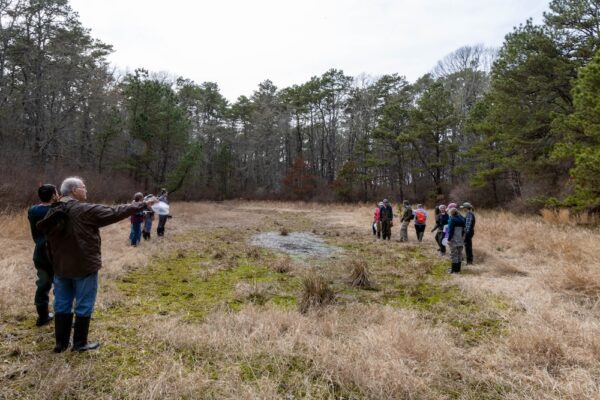
Involvement in these activities, while well-suited to volunteer citizen scientists, should be done under the oversight of conservation professionals following standard protocols and best practices. The CBI provides hands-on trainings to partner organizations and their volunteers. To request a training in your area, please email us. For a brief overview of best practices, see below:
- Land access and safety: Landowner permission must be obtained prior to site visits. Field teams will consist of 2–3 individuals to balance safety and minimize habitat disturbance. All team members must carry charged mobile phones and appropriate lighting when working near dusk.
- Wildlife handling restrictions: Amphibians and egg masses will rarely be handled. Photographic documentation will be obtained using non-invasive methods (e.g., white background trays). When handling is unavoidable, sterile nitrile gloves will be used and disposed of between sites.
- Protection of state-listed species: Handling, touching, or harassing state-listed species will be avoided, except in rare cases where appropriate permits have been acquired. Observations of listed species will be documented and reported directly to NHESP, with location data kept confidential to prevent disturbance by over-visitation or poaching.
- Minimizing habitat disturbance: In wetlands, time spent wading and sediment disturbance will be minimized. Once sufficient evidence is collected, teams will exit the wetland. Where appropriate, passive acoustic monitoring (e.g., recording calling wood frogs) will be used as an alternative to repeated physical entry.
- Disease prevention: Visits to multiple wetland sites during a single outing will be limited to nearby sites only. All gear will be sanitized off-site between outings following the Northeast Partners in Amphibian and Reptile Conservation (PARC) Protocol, as recommended by MassWildlife.
For conservation organizations
If you represent a conservation organization and are interested in joining the initiative, please contact us to schedule a partner onboarding discussion. Prospective partners should also review the required Partner Pledge.
Inquiries may be sent to info@dennisconservationlandtrust.org
Once onboarded, Partners will be welcomed to the community, invited to field trainings, and provided a variety of guidance resources including:
- Access to a custom Google Maps tool tailored to your specific service area
- Access to our email listserv: https://groups.io/g/communitybiodiversity
- Access to free, in-person taxonomic trainings, biodiversity monitoring technology trainings, and vernal pool certification workshops
- Template landowner permission letters
- Template field data sheets for vernal pools and rare species
- A shared equipment library, including wildlife cameras, passive audio recording devices, and more
For individuals
If you are an individual interested in participating, we encourage you to contact your local land trust, watershed group, pond association, conservation department, or natural resources department. Provide them a link to this webpage and express your interest in getting involved in your location. If you are unsure who to contact in your community, feel free to email us and we will try to help connect you with someone appropriate.
Other Resources
- Slide deck from DCLT and Hilltown Land Trust’s joint presentation on 3/13/2026 at the Mass Land Conservation Conference
- MassWildlife’s Natural Heritage Program
- MassWildlife’s Vernal Pool Certification Program
- Guidelines for the Certification of Vernal Pool Habitat
- Uploading Species Observations to Heritage Hub
- Vernal Pool Association’s Certification Guidance
Acknowledgments
The Dennis Conservation Land Trust thanks those who founded this initiative: David Fryxell, Ph.D., Jen Clifford, Fernando Mendonca, Ph.D. (Peregrine Ridge Consulting), Leeza Barstein, Ann Risso, Gail Hart, Sharon Stewart, Charly Raymond, and Lydia Rheinhardt.
For funding, we thank the Island Foundation, Joseph and Rosemary Masse, John and Deborah Todd, Kate Byron, Sharon and Ford Stewart, and an anonymous donor.
For advice, we thank Tim Simmons, formerly of NHESP; Matt Penella, Kingston Conservation Agent; Micah Jasny of NHESP; Rebecca Quiñones of NHESP; Owen Nichols with the Center for Coastal Studies; Andrea Bogomolni of the Island Foundation; Brad Timm of Northeast Wildlife Team; Nathan Cristofori, PWS, with the Town of Plymouth; Scott Smyers of Oxbow Associates; Nellie Wilson and Hilltown Land Trust; and many others.